Issue 02 · November 2026 · Table Tennis / Operations
Table Tennis Business: Is it the Next Big European Racket Sport Boom?
Explore the table tennis business model compared to padel and pickleball, analyzing setup costs, spatial footprints, and social venue revenue.
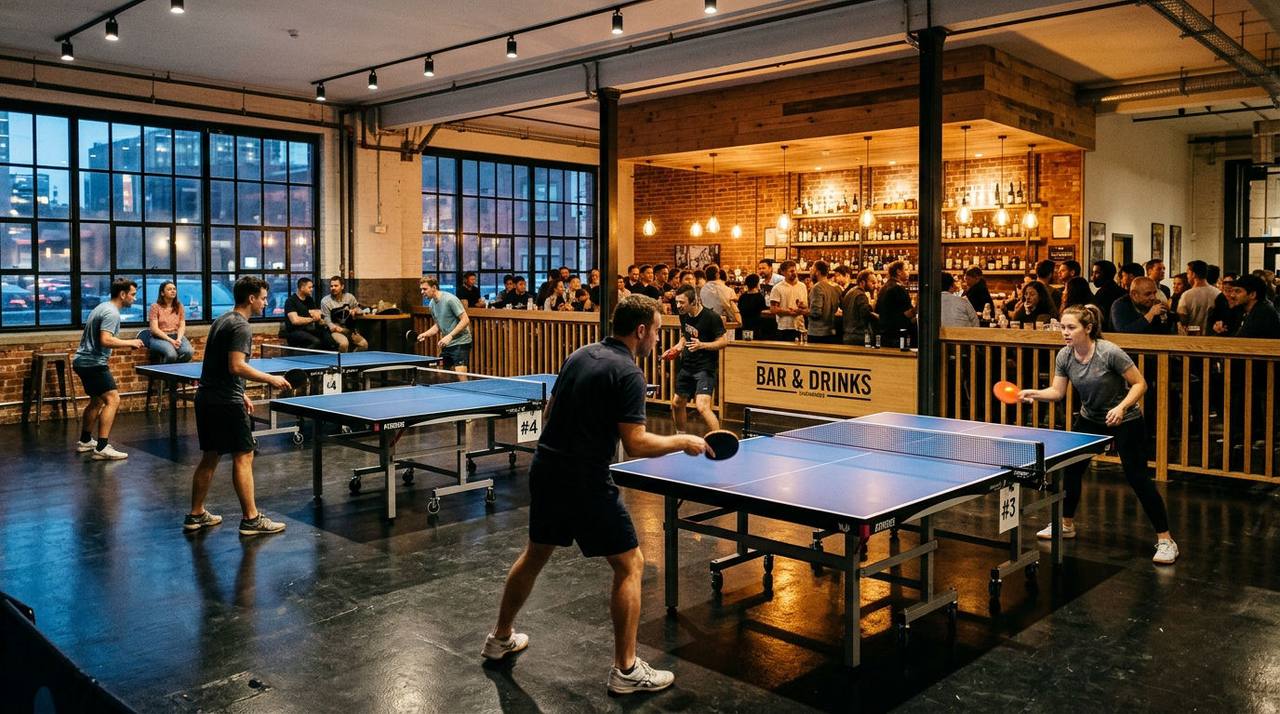
Evaluating whether a table tennis business represents the next major commercial racket sport boom in Europe requires looking past the current padel hype and examining hard participation and setup metrics. While industrial padel warehouses soak up millions in capital across suburban business parks, a single social table tennis bay requires only 25 to 30 square metres and €1,100 to €2,550 in setup capital expenditure.
For venue operators who want immediate cash flow, high customer density, and strong secondary food and beverage spend without taking on massive structural footprint risks, social ping-pong is emerging as the sharper operational play.
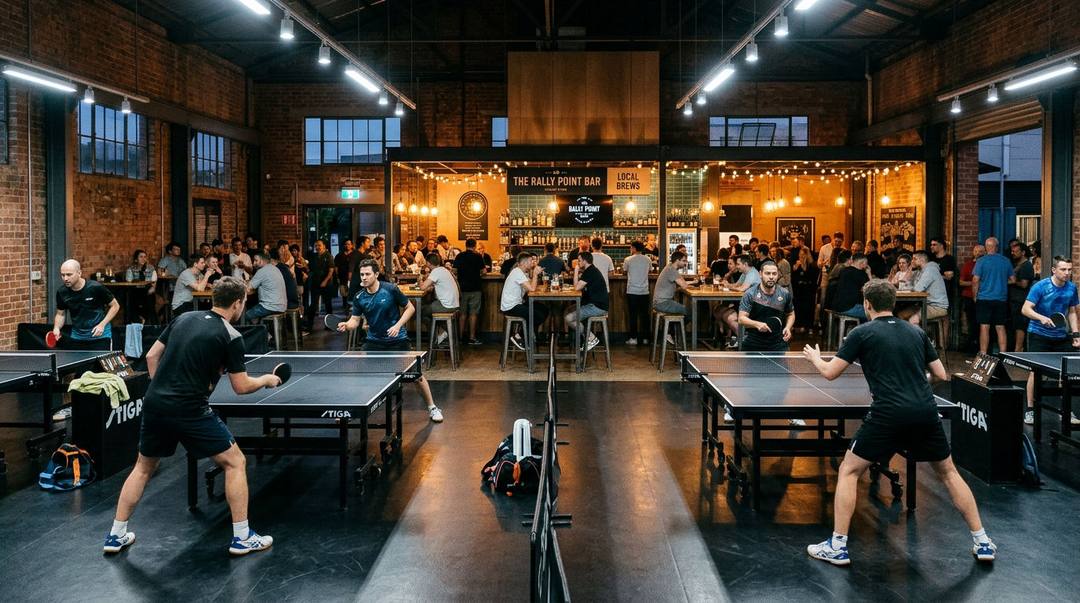
The Global Racket Sport Landscape in Numbers
Most commercial sports investors look at Western trend pieces and assume padel and pickleball represent the entire universe of racket sport growth. That view misses the broader global foundation entirely.
Table tennis has around 300 million global players, with the vast majority located in Asia. By comparison, padel counts roughly 36 million players, mostly concentrated across Spain, Italy, Sweden, and emerging European hubs. Pickleball sits at around 29 million players, with the vast majority of that base situated in North America.
Table tennis maintains more than ten times the active player base of pickleball and over eight times that of padel. It is not an unproven novelty or an imported fad trying to build grassroots awareness from nothing. The sport has existed in schools, community centres, garages, and municipal basements across Europe for generations. People already know how to play.
What has been missing across European high streets and leisure districts is not player awareness, but modern commercial packaging. Looking at European high streets, I noticed how traditional clubs kept table tennis locked away under flickering tubes in municipal basements, leaving commercial city centres wide open. That legacy left a massive commercial vacuum.
When operators rethink the sport through the lens of modern social entertainment—following concepts pioneered by operators like Bounce in London or SPIN in North America—the player pool is already primed. Guests do not need an introductory coaching clinic just to sustain a four-shot rally.
Comparing Capital Expenditure and Footprint Models
The financial case for table tennis becomes obvious the moment you evaluate setup capital expenditure alongside square-metre requirements. Real estate overhead remains the single largest recurring liability for any racket sports operator.
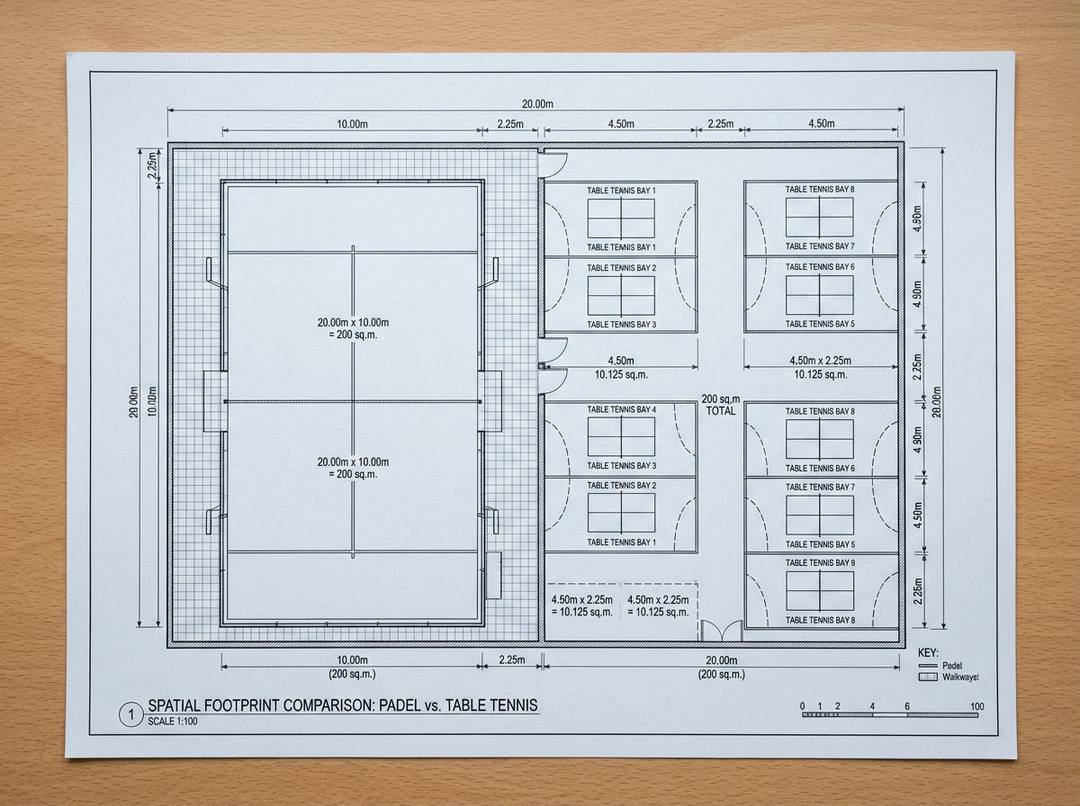
A standard commercial padel court demands roughly 200 square metres of footprint, plus additional perimeter run-off and clear ceiling heights of eight to ten metres. An indoor pickleball court requires between 140 and 180 square metres (1,500 to 1,950 square feet) alongside substantial lateral spacing. In contrast, a social table tennis bay occupies just 25 to 30 square metres (270 to 320 square feet) with ceiling clearances as low as 3.0 metres. The math is brutal.
| Metric | Social Table Tennis Bay | Indoor Pickleball Court | Indoor Padel Court |
|---|---|---|---|
| Footprint per Unit | 25 to 30 sq m (270 to 320 sq ft) | 140 to 180 sq m (1,500 to 1,950 sq ft) | ~200 to 220 sq m |
| Clear Ceiling Height | 3.0 to 3.5 m | 5.5 to 6.5 m | 8.0 to 10.0 m |
| Hardware & Net Setup | €600 to €1,200 | €1,200 to €2,500 | €18,000 to €35,000 |
| Surface & Prep Work | €0 to €300 | €3,800 to €8,300 | €8,000 to €15,000 |
| Lighting Array | €250 to €500 | €2,000 to €4,000 | €3,000 to €6,000 |
| Dividers & Containment | €150 to €350 | €1,000 to €2,500 | €4,000 to €8,000 |
| Assembly & Labour | €100 to €200 | €1,500 to €3,000 | €5,000 to €10,000 |
| Total CAPEX per Unit | €1,100 to €2,550 | €12,500 to €25,500 | €38,000 to €74,000 |
Here is how those figures work out in practice. For a social table tennis bay, heavy-duty commercial or robust 19mm to 22mm club tables cost between €600 and €1,200. Utilizing an existing concrete slab requires zero structural anchoring, with surface line marking or vinyl boundary tape running between €0 and €300. One or two suspended overhead track fixtures cost €250 to €500, while perimeter fabric barriers or low planter boxes run €150 to €350. Adding €100 to €200 for flatpack assembly keeps your total upfront cost per bay between €1,100 and €2,550.
Compare that to an indoor pickleball court. Setting up a pickleball court starts with €1,200 to €2,500 for heavy-duty nets, plus €300 to €800 to core-drill sleeve mounts into your slab before multi-layer acrylic sports paint adds another €3,500 to €7,500 and installation labour doubles that prep work. Factor in €2,000 to €4,000 for overhead LEDs and basic perimeter netting, and your total baseline easily reaches €12,500 to €25,500 before doors open. It adds up fast.
Padel pushes those capital requirements into an entirely different league. Erecting structural steel uprights, ten-millimetre toughened glass walls, specialized silica-dressed monofilament turf, and high-mast floodlights routinely pushes court installation beyond €40,000 per bay.
When I ran the numbers across a 300-square-metre lease, the trade-off was stark: one padel cage earning court fees from four players an hour, or eight table tennis bays packing in up to 32 active guests spending money across the counter.
The Economics of Social Venue Setup
Turning an empty shell into an active table tennis club does not require an eight-month commercial development cycle. You can bring a multi-table social venue from lease signature to public launch over a standard three-month buildout. Speed to market is the secret weapon here.
In the first month, you lock down the unglamorous foundations. That means signing the lease on a light industrial warehouse or commercial basement shell, securing your municipal assembly permits, and sorting out your leisure and basic drinks licenses. During our month-one setup, I made sure we ordered eight 22mm commercial tables and overhead LED tracks simultaneously, avoiding weeks of shipping downtime while finalizing our leisure permits. This is also the moment to implement an automated booking system that manages court reservations, split payments, membership tiers, and corporate buyout ticketing without requiring front-desk friction.
By month two, you transform the space on a disciplined budget. The fastest and most durable floor treatment involves cleaning and sealing the raw concrete with a dark epoxy coating. Dark grey or deep navy epoxy creates crisp visual contrast against white balls without the enormous capital expense of floating timber sports floors. During this second phase, hang glare-free track lights directly over each bay, position a casual bar counter with wide drink rails, and test your point-of-sale terminals while pitching local corporate offices for weekday team nights.
Month three brings the venue to life. You assemble and level the eight tables, test the sound system zones to ensure music does not overpower table conversation, and host an invite-only soft-launch week with nearby business owners, local social clubs, friends, and hospitality staff to run the venue under real load.
That trial period lets you iron out kitchen bottlenecks, dial in table spacing, and train staff on equipment rental handoffs before launching regular weekday social leagues and Thursday corporate tournaments.
Layout Strategies and Revenue Maximisation
The layout of your venue dictates whether you operate a low-margin sports hall or a high-yield social entertainment destination. The most common mistake venue owners make is swinging entirely toward one operational extreme.
Some operators build sterile tournament halls with cavernous run-backs, zero seating, and whisper-quiet atmospheres that alienate casual spenders. Others cram tables directly against cocktail booths where errant backhands hit drinking guests in the ribs, driving away serious racket players who care about actual gameplay.
I saw this exact problem when evaluating room layouts:
"If a bay is too strict in space and I can only fit up to four players, it can be off-putting for larger groups who will spend more money."
I have played in table tennis spaces that are neglected and shoved into a corner of racket clubs and bars, where nobody plays because the layout feels like an afterthought. That neglect convinced me that dedicated, well-lit bays with wide drink rails are non-negotiable. To maximize revenue potential, design a hybrid floor plan. Position several dedicated social play areas across the high-traffic zones of the room for casual groups who care about music and drinks. Protecting two or three bays with competition run-off and premium club tables for committed league players. Casual spectators drive your bar margin.
Friends who come along to watch are the customers driving your secondary spend. They order craft beers, share snacks, buy merchandise, and create the lively social hum that keeps groups extending their table time. Build out generous peripheral perches and ensure that access to drinks and food is completely frictionless from every corner of the playing floor.
Why Padel Dominance Misses the Bigger Picture
Commercial sports analysts spend an enormous amount of time tracking padel court installations across Europe, yet they often misread the broader racket sport landscape. Their analysis assumes that because padel is booming, capital should flow exclusively into high-ceilinged suburban industrial sheds.
That perspective ignores player behaviour. Racket sports players are naturally multi-sport participants who enjoy experimenting with different games. It is rare to meet an active tennis player who has never picked up a padel bat, a pickleball paddle, or a table tennis blade.
I've watched that pattern play out across every racket club I visit:
"Rarely do you find a tennis player who has never played pickleball, padel, or table tennis. Most are multi-sport, and very importantly, most racket sports players enjoy or play table tennis."
Working on Six Love, I watch racket players move fluidly between tennis leagues on Saturday, padel matches on Tuesday, and social ping-pong on Thursday without blinking. A player does not abandon one sport to pick up another. Table tennis does not need to beat padel to win.
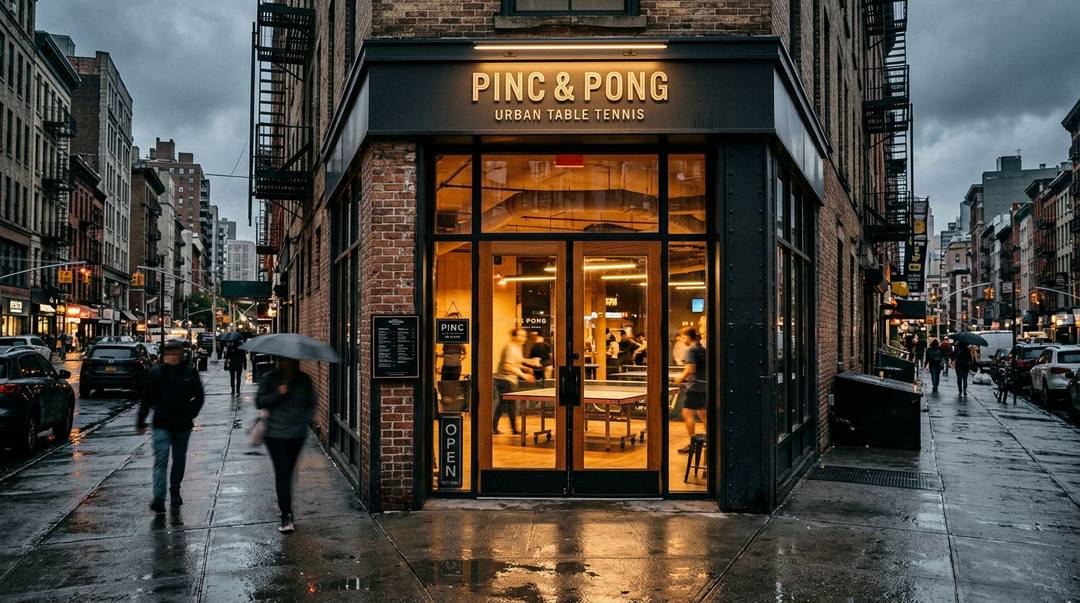
A padel venue generally requires a 1,500-square-metre out-of-town warehouse with ten-metre roof clearance, ample surface parking, and car-dependent customer access. That model struggles to capture casual after-work foot traffic on a rainy Wednesday at 6:00 PM. A social table tennis lounge can open in a 400-square-metre subterranean space directly beneath a major transit station or commercial office district, thriving on impulse footfall and corporate party budgets that padel facilities simply cannot service.
Practical Next Steps for Venue Operators
If you are evaluating whether to launch a social table tennis club in your market, move past abstract financial projections and validate local demand with concrete operational steps.
- Audit local urban real estate: Look for commercial basements, former retail spaces, or underutilized hospitality footprints with 3.2-metre ceiling heights that fail the requirements for traditional gyms or padel courts.
- Model your revenue on a 60/40 split: When I sit down with prospective operators, I tell them to model revenue on a strict 60/40 split, counting on table fees for 60% of turnover and bar receipts for the remaining 40%.
- Source heavy-duty commercial hardware: Never cut costs with flimsy folding home tables; invest in 22mm tournament-grade tops with fixed steel undercarriages that withstand intense commercial wear.
- Partner with local corporate networks: Before your soft launch, secure commitments from five to ten local employers to anchor your off-peak corporate league nights.
High density and low overhead beat empty warehouse volume every time.
This model is built specifically for hospitality operators, sports entrepreneurs, and venue developers who want exceptional yield per square metre without taking on millions of euros in structural construction debt. Conversely, if you are looking to run an unstaffed, court-fee-only athletic barn with zero food and beverage integration, table tennis will frustrate you. Its commercial power lives at the intersection of casual sport, high player density, and vibrant hospitality.
Where to Build Your First Venue
Opening a table tennis venue comes down to seizing the massive urban footprint advantage that padel and pickleball simply cannot touch. If you want high player density, low entry CAPEX, and immediate after-work foot traffic in the middle of the city, table tennis is the smarter commercial bet. Target vacant urban shells like downtown basements or ground-floor retail footprints with 3.2-metre ceilings that landlords struggle to lease to conventional sports operators.
Protect your hospitality margins by building a proper bar counter directly alongside the tables, ensuring food and drink receipts carry the venue during quiet afternoon lulls. Finally, lock in corporate leagues before opening day by signing five to ten local office networks for Thursday tournaments to guarantee predictable weekly baseline revenue.
FAQ
What ceiling height is needed for a commercial table tennis venue?
A social table tennis venue operates comfortably with ceiling heights between 3.0 and 3.5 metres, making standard commercial basements, ground-floor retail units, and legacy office spaces completely viable without structural roof modifications.
What floor surface works best for high-traffic social play?
A sealed dark epoxy concrete floor provides the most durable, cost-effective base for social play, offering excellent ball visibility, effortless spill cleanup, and zero recurring replacement costs compared to traditional sports vinyl or timber.
How much should an operator charge for table rentals?
Social urban venues typically charge between €20 and €45 per table per hour depending on peak evening windows, offering discounted daytime rates or monthly subscription passes to anchor consistent weekday footfall.