Issue 02 · November 2026 · All / Software, Operations, Member Experience
Rackets Club Membership Models Compared
Compare pay-as-you-go, all-access, and hybrid rackets club membership models. Real utilization benchmarks and revenue predictability for club operators.
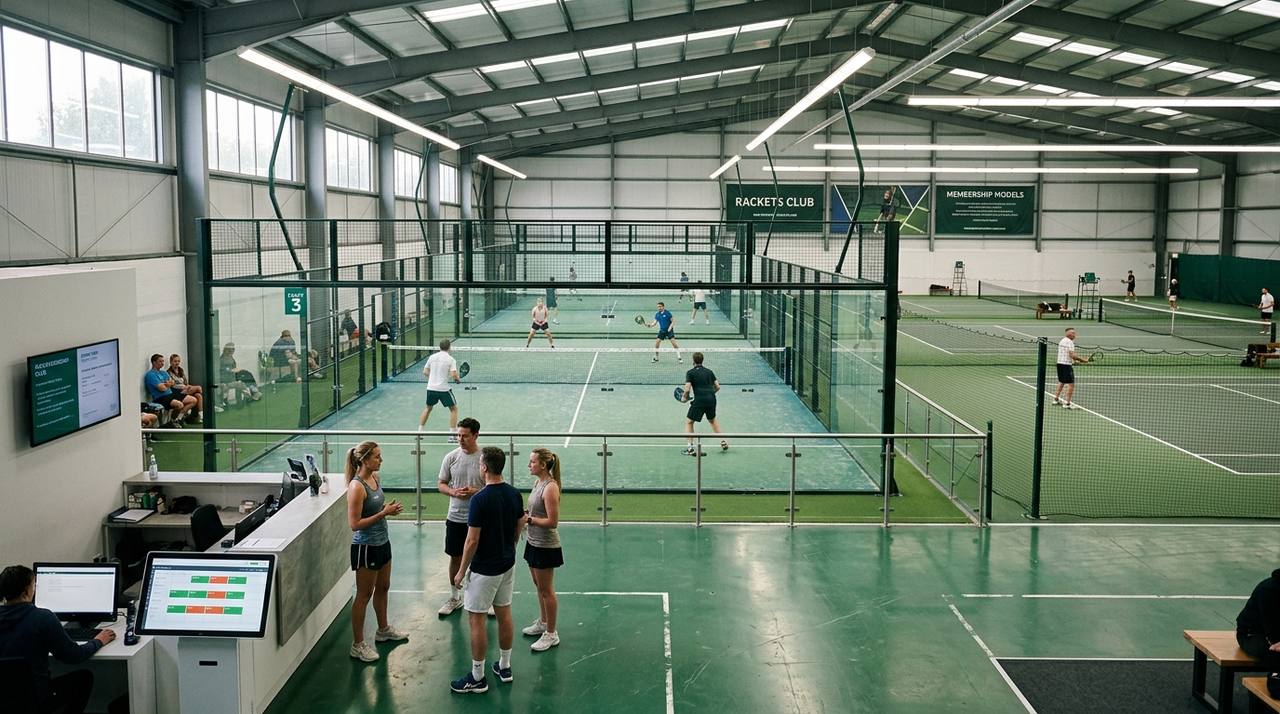
When evaluating rackets club membership models for a new facility, operators face a fundamental tension between unpredictable transient revenue and rigid monthly subscriptions. Setting up a commercial facility forces an immediate financial crossroad: lock players into recurring contracts, charge per court hour, or stitch together a blend of both.
Cash flow breaks clubs early.
With most venues needing a 40 to 50 percent court use rate just to break even, three criteria decide which setup works: revenue predictability, inventory balance across peak hours, and player booking friction. While no single setup fits every territory, a hybrid tier balances these trade-offs best for modern multi-court operators. It secures steady cash flow through a tiered monthly fee while modular booking credits keep schedules flexible. Pure pay-as-you-go drop-in access scatters player loyalty, while full all-access memberships clog peak hours and leave off-peak capacity stranded.
Revenue Predictability Across Rackets Club Membership Models
A club's survival hinges on steady cash inflow rather than speculative weekend traffic. Even a lean rackets club needs at least a 30 percent court use rate, and that holds true only when debt service and staffing costs are kept exceptionally low. For most clubs, they start to break even around the 40 to 50 percent rate.
Markets where courts are in undersupply often have the ability to charge higher rates, meaning that they reach profitability with slightly lower use. But once those markets mature, they get much more competitive. Empty courts bleed payroll when relying solely on transient foot traffic, an approach that backfires quickly, as I put it to operators:
"When relying solely on a pay-as-you-go model, club owners often assume it yields higher returns in busy urban markets where transient players pay per booking. But that approach erodes player loyalty and scatters your court traffic across multiple competing facilities."
In our facility planning, implementing a structured membership tier tied players to our home venue, which stabilized baseline court use while feeding dependable ancillary spend through pro shop merchandise and café registers.
Court Utilisation Trade-Offs in Padel, Tennis and Pickleball
Balancing court inventory across peak and off-peak hours exposes the limits of rigid membership frameworks. Peak evening slots fill instantly under flat-rate subscriptions, leaving regular players frustrated and off-peak daylight hours empty. Prime slots vanish instantly.
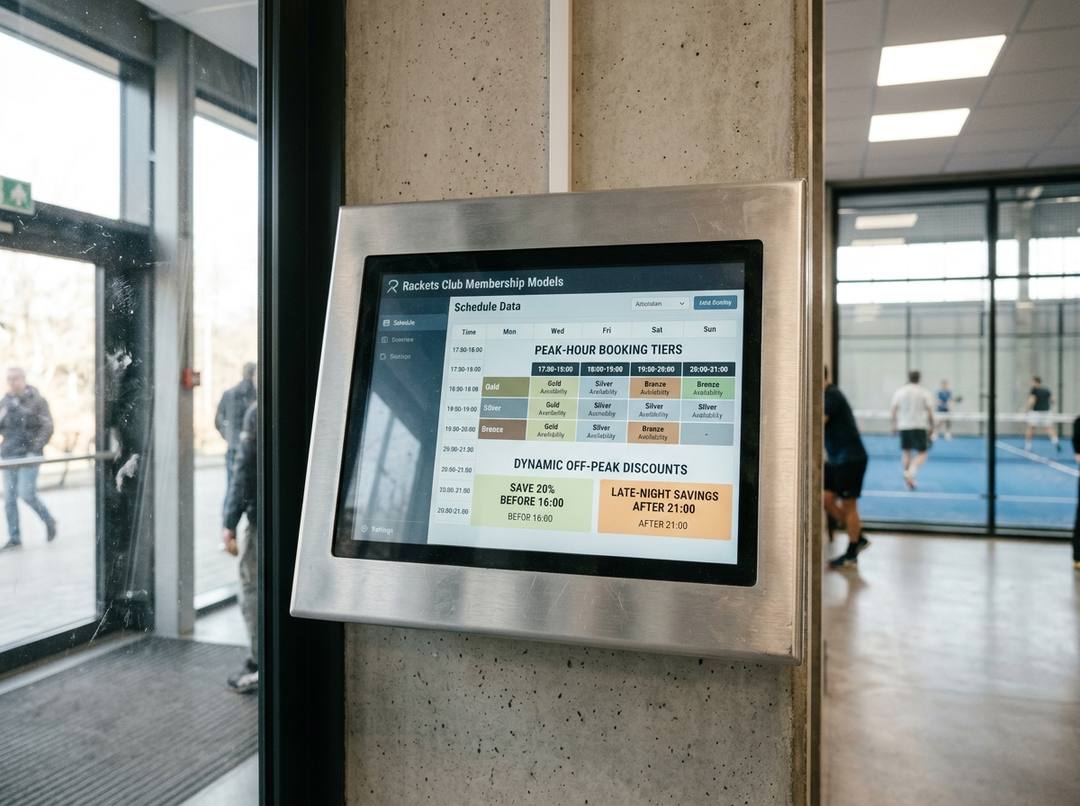
Uncapped memberships deliver reliable monthly cash flow, but regulars quickly monopolise prime evening slots between 6:00 PM and 10:00 PM, which leaves midday daylight courts deserted. Pay-as-you-go pricing frees up off-peak inventory through dynamic discounts, yet exposes operators to crippling seasonal slumps whenever bad weather or holidays clear the courts. In our own scheduling tests, a hybrid model captured the upside of both by using advance booking tiers to protect high-yield evening hours while discounted credit rates pulled recreational traffic into empty afternoon slots.
Player Booking Friction and Regional Market Preferences
Booking friction looks completely different depending on which country your club operates in. Payment habits vary widely across borders, and forcing a foreign membership convention onto an unprimed regional demographic can stall club growth entirely. Culture dictates booking behaviour.
In Spain, where padel is extremely mature, pay-as-you-go systems dominate. Spanish players are accustomed to opening Playtomic, finding three other players, splitting a 90-minute court fee, and walking away with no contractual tie to the venue, even if third-party app booking commissions quietly shave operator margins on every match. Try selling an exclusive €150-a-month subscription in Madrid, and players will simply book at the municipal center down the road.
In America and the United Kingdom, it is much more common to run on high-end premium memberships. Players in London or New York expect an exclusive clubhouse environment, dedicated locker rooms, curated social mixers, and the status that comes with an all-inclusive monthly fee.
Italy leans heavily toward hybrid models that bundle member privileges into tiered options. Italian operators frequently charge an annual association fee or a modest monthly tier that grants discounted court pricing, early access to clinics, and internal tournament entry.
For international club operators, the lesson is straightforward: forcing players through restrictive booking gates in a drop-in culture clears out your courts. Failing to charge recurring dues in high-overhead markets leaves your business exposed to brutal fixed-cost pressures.
Comparing Rackets Club Membership Models Side by Side
The operational reality of each model shapes long-term club profitability. Every model carries baggage.
Product | Price | Best use case | Standout feature | Trade-off |
|---|---|---|---|---|
Pay-as-you-go drop-in | Variable per booking | Urban transit markets with high tourist or casual volume | Low barrier to entry for transient players | Erodes player loyalty and scatters court traffic |
Full all-access membership | High monthly recurring fee | Affluent suburban or established club markets | Guaranteed predictable recurring revenue | Creates booking friction and leaves off-peak capacity underutilized |
Hybrid membership tier | Tiered monthly fee plus modular booking credits | Mixed urban-suburban markets with diverse player demographics | Balances steady cash flow with flexible data gathering | Requires more complex administrative management and tier structuring |
Choosing the Right Model for Your Local Demand and Capacity
Setting your membership structure requires looking beyond whatever your immediate competitors down the road happen to be doing. It's common to assume because everyone else is doing it, it must be the best approach. Sometimes you need to look at other markets, especially more mature ones, and even visit them to understand which models work best in which situations. It's going to be different for every club depending on demand and affluency in the area. Getting this right can be key to growing your club. Copying rivals breeds failure.
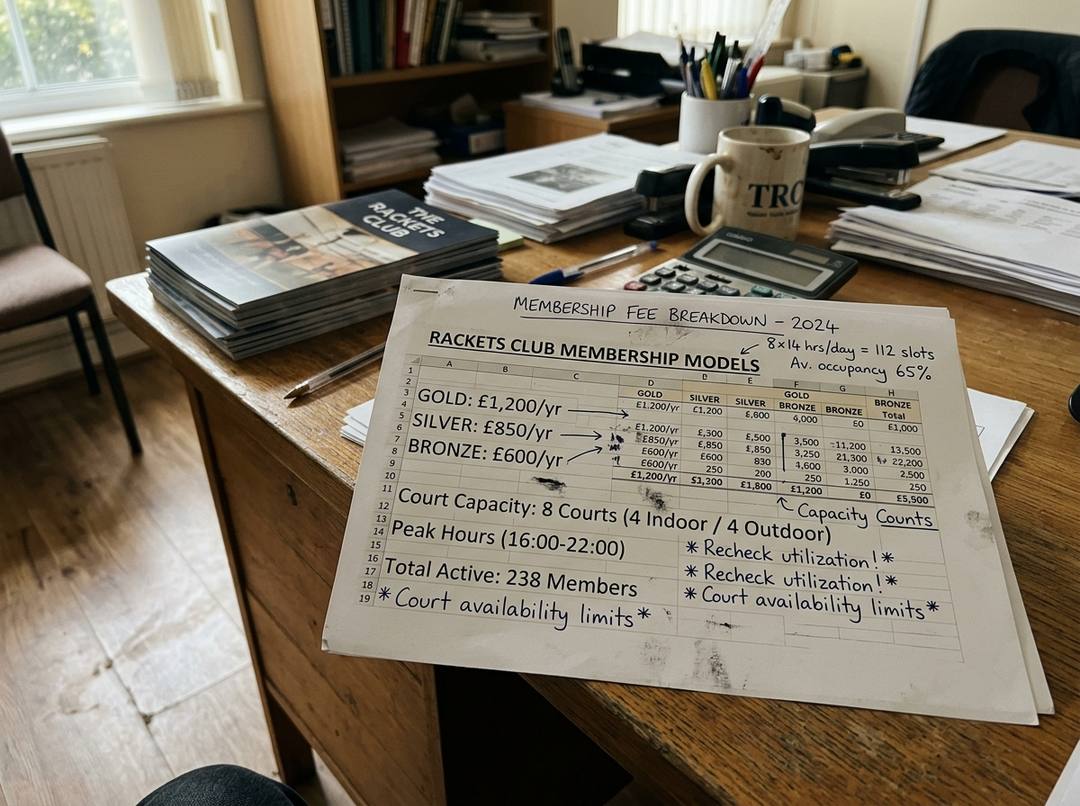
Facility scale dictates the model before player demographics even enter the equation. Operators running fewer than four courts cannot sustain unlimited subscriptions without triggering instant peak-hour gridlock. Larger facilities can absorb member volume while reserving off-peak capacity for clinics and public play.
Demographics and back-office capacity settle the rest. Affluent suburban clubs can support high monthly dues paired with guest fees, but price-conscious urban corridors depend on open access to stay above break-even. Behind the desk, tiered credits require platforms like CourtReserve to automate member booking windows, preventing the staff friction that destroys club margins. A hybrid tier or structured pay-as-you-go framework protects peak-hour access so multiple player groups can actually get on court.
When operators ask me whether this comparison represents an even split, I tell them plainly:
"Hybrid wins because it offers something for all player types and allows the club to monitor data on which is the most profitable way forward. If they then choose at a later date to commit to one or the other, they will have the right data to help them make the best choice."
If you run a high-volume venue in a mixed metropolitan area, use a hybrid model today. Operators running single-court, tourist-heavy pop-ups should stick to pure pay-as-you-go, while traditional, multi-sport private clubs with significant real estate can still justify the all-access route.
What I'd Set Up First
Picking a club model comes down to locking down court hours before local supply outpaces demand, protecting baseline cash flow without choking off booking sheets. Audit your projected court fill rate between 6:00 PM and 10:00 PM before committing to an unlimited membership framework. Using tiered booking credits keeps your overhead covered through a modest recurring fee while charging appropriately for prime court slots, leaving you free to review software analytics monthly and tweak off-peak pricing before empty hours eat away your margins. Ensure you visit local and national racket sports expos. They are a great way to know what's going on in the industry.
FAQ
How do software platforms like CourtReserve handle hybrid rackets club membership models differently than traditional spreadsheets?
Automated booking windows and credit tracking software prevent administrative gridlock when operators mix monthly subscriptions with per-hour fees. Without these tools, tracking modular credits across dozens of players creates severe front-desk friction.
What specific software or automation tools do you rely on to manage tiered booking credits without burning out front desk staff?
I recommend using a white label booking system, as I have found that marketplace apps are good for discovery while keeping you from ever truly owning your players, which can create a lot of problems down the line.
Can a brand new rackets club launch with a pure pay-as-you-go model if local market demand is completely unproven?
Launching without any recurring revenue baseline in an unproven market exposes a new club to immediate cash flow risks from seasonal slumps. Most operators need at least some predictable monthly dues to cover fixed debt service and rent.
How do multi-court operators handle guest pass policies within a hybrid rackets club membership model?
Operators typically allocate a fixed number of guest credits per month within higher membership tiers to encourage transient player acquisition without eroding primary court inventory. Excess guest play is then billed at standard transient rates.